
COURSE ARCHITECT OPERATING SYSTEM · COGNITION BLUEPRINT
Whatever you teach, build it the way learning works.
Photography. Knitting. Baking. Physics. The subject changes. How people learn doesn't. Forty lessons on designing your course around six pillars of how learning works, so your students keep what you teach them.
Every claim referenced. Rigorous enough to teach an academic something new. Clear enough for anyone who has ever taught a class.
8 modules · 40 lessons · a video, a workbook and a quiz in every lesson
15 years inside higher education.
Course Leader, Programme Leader, Dean of Faculty, and Visiting Professor at the University of São Paulo. Four undergraduate degrees designed and hundreds of courses built, from foundation level to CPD.
More than 500 referenced works.
From Ebbinghaus's memory experiments of 1885 to meta-analyses published this decade.
Real courses, real decisions.
Every example comes from real course design, with names, places and figures removed.
Built the way it teaches.
The course uses every principle it covers, so you see each one working before you use it.
01 — The problem
The end of a good lesson is the worst time to judge it.
At the end of a good session, everything looks right. Hands go up. Answers come quickly. The feedback is warm. None of that tells you whether your students will still know it next month.
Researchers call this the gap between performance and learning. Performance is what you can see while the lesson is happening. Learning is what is still there once the lesson is over and the prompts have gone (Soderstrom, N. C., & Bjork, R. A. (2015). Learning versus performance. Perspectives on Psychological Science, 10(2), 176–199. https://doi.org/10.1177/1745691615569000).
The gap catches everyone. In one classic study, students who reread a passage did better on a test five minutes later than students who practised recalling it. Two days later, and again a week later, the recall group was well ahead. An end-of-lesson check would have crowned the wrong method (Roediger, H. L., & Karpicke, J. D. (2006). Test-enhanced learning. Psychological Science, 17(3), 249–255. https://doi.org/10.1111/j.1467-9280.2006.01693.x).
And students can't feel it either. In a randomised comparison with identical course materials, students in active classes learned more than students in polished lectures, yet felt they had learned less (Deslauriers, L., McCarty, L. S., Miller, K., Callaghan, K., & Kestin, G. (2019). Measuring actual learning versus feeling of learning in response to being actively engaged in the classroom. Proceedings of the National Academy of Sciences, 116(39), 19251–19257. https://doi.org/10.1073/pnas.1821936116).
So a course can feel excellent and teach very little. Or feel like hard work and teach a great deal.
02 — The answer
Design for what lasts, not for what looks good on the day.
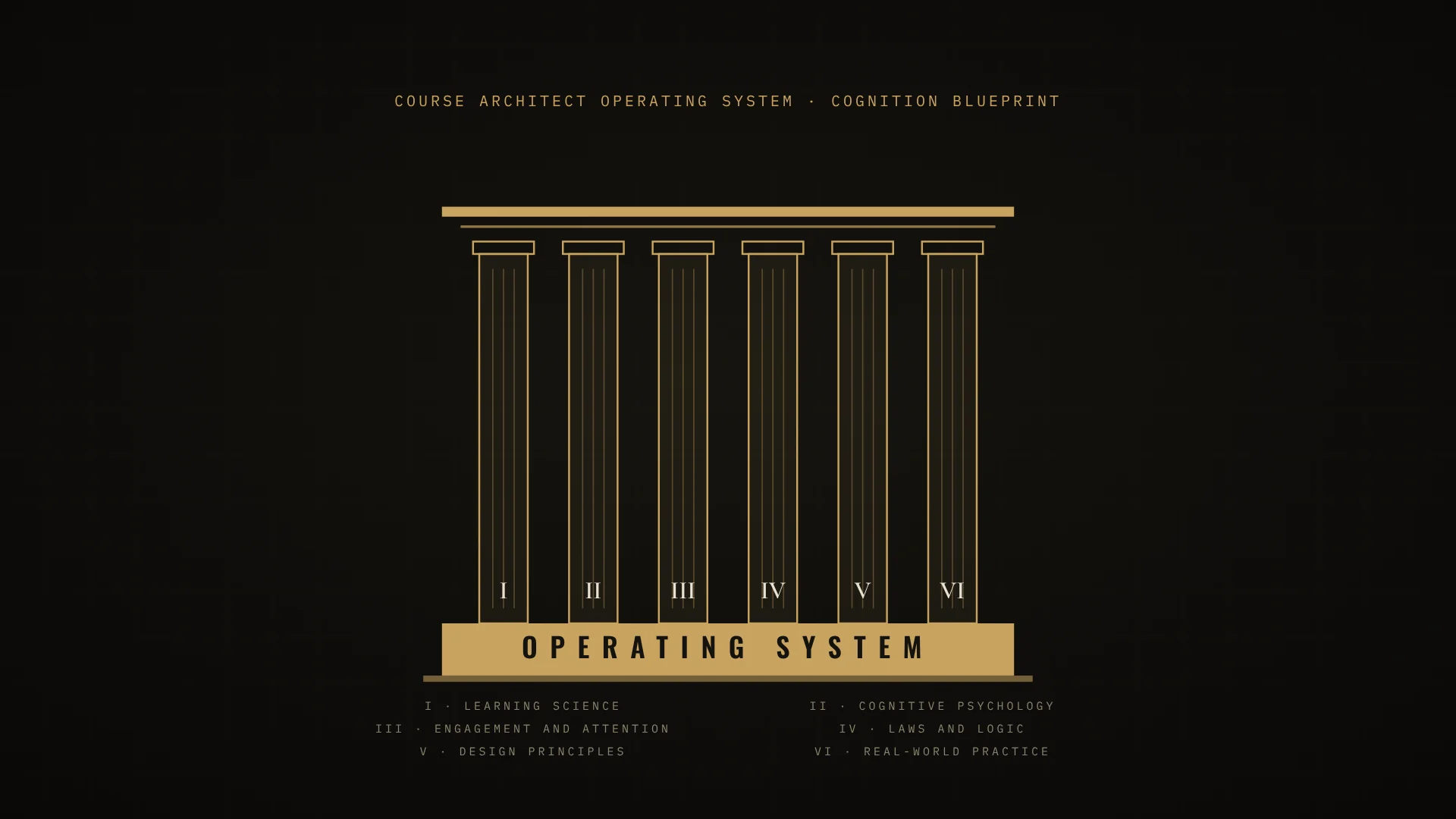
Course Architect Operating System teaches you to design around how memory, attention and reasoning actually work, instead of around a list of content. It does that through six pillars: Academic Method's own framework for building courses, drawn from fifteen years of designing them and from the research as it stands today.
Six pillars. One course built on all of them.
- I
Learning Science
Does the learning survive after the course ends? Retrieval, spacing, interleaving and the other practices that make learning last.
- II
Cognitive Psychology
What does the way the mind works demand from the way a course is built? The limits of working memory, cognitive load, and building on what learners already know.
- III
Engagement and Attention
Attention comes first. Engagement isn't decoration; it's the mechanism that makes the other pillars possible.
- IV
Laws and Logic
The principles well-built systems run on, the conditions under which each holds, and the reasoning that connects it to a design choice. Every load-bearing decision must be defensible.
- V
Design Principles
Designing the lesson itself: starting from the learner, being specific about outcomes, working within your constraints, and cutting whatever distracts.
- VI
Real-World Practice
What works on the ground: documented cases, course maps, sequencing decisions, and the loop of testing and improving a course with real learners.
The pillars aren't separate subjects. Every lesson shows where it connects to the others, because in a real course they all act at once.
03 — Inside every lesson
Forty lessons, each built the way it teaches.
A video.
About eight to ten minutes for teaching lessons, six to eight for assessment lessons. Written to work as audio too, so you can listen on a walk.
A lesson page that goes deeper.
For each piece of research: what was done, what was found, what it means for your course, and where it stops.
A workbook.
Each lesson adds a step to the redesign of your own course, so by the end you have done the work, not just read about it.
A quiz.
Built to test whether you can use the idea, not whether you remember a name.
04 — The curriculum
Eight modules, from first principles to your own redesigned course.
Module 0 · Welcome, Architect
Why courses fail, the difference between content and architecture, the map of the whole course, and a two-sided learning contract: what you commit to, and what the course commits to in return.
Module 1 · Learning Science
Why performance during a lesson misleads. Retrieval and generative practice, spacing and interleaving, transfer, and assessment that measures what lasts.
Module 2 · Cognitive Psychology
Working memory is finite. Cognitive load, how to budget a learner's attention across a lesson, and how prior knowledge and expertise change what a learner needs.
Module 3 · Engagement and Attention
Attention as the first condition for learning. How to open a lesson, pace it, and bring learners back across a whole course.
Module 4 · Laws and Logic
Laws and principles from every field with evidence behind them, labelled with where they come from and how far they carry, and the logic that turns each one into a defensible design decision.
Module 5 · Design Principles
Function first. Visual hierarchy, structural rhythm, cutting what distracts, and designing for every learner.
Module 6 · Real-World Practice
The traps that catch real courses, what experienced practitioners know, how to research your learners, and the loop of testing and improving a course once it runs.
Module 7 · Synthesis
Judging a course design as an architect would. Where the six pillars pull against each other, how to make improvement a habit, and a final audit of your own course against all six.
05 — Who it's for
For anyone who teaches anything. Rigorous enough for those who teach for a living.
If you teach a skill, a craft or a subject
Workshops, online courses, evening classes, coaching. Photography, knitting, baking, music, languages, software. No education background assumed: every term is explained the first time it appears, and every idea is shown on a real course before you use it on yours.
If you work in education
Lecturers, programme leaders, instructional designers, trainers. The evidence is current, contested findings are named as contested, and every claim carries a reference you can check.
“I've been teaching for fifteen years, and researching this course still taught me a lot.”
Kevin Fenemore
06 — The rigour
We tell you what the research says. And where it stops.
- 01
Performance isn't learning.
What learners do during a lesson is a poor guide to what they keep (Soderstrom, N. C., & Bjork, R. A. (2015). Learning versus performance. Perspectives on Psychological Science, 10(2), 176–199. https://doi.org/10.1177/1745691615569000).
- 02
The wrong method can win the end-of-lesson test.
Rereading beat recall after five minutes and lost after two days and a week (Roediger, H. L., & Karpicke, J. D. (2006). Test-enhanced learning. Psychological Science, 17(3), 249–255. https://doi.org/10.1111/j.1467-9280.2006.01693.x).
- 03
Learners misjudge their own learning.
Active classes taught more and felt like less (Deslauriers, L., McCarty, L. S., Miller, K., Callaghan, K., & Kestin, G. (2019). Measuring actual learning versus feeling of learning in response to being actively engaged in the classroom. Proceedings of the National Academy of Sciences, 116(39), 19251–19257. https://doi.org/10.1073/pnas.1821936116).
- 04
Good intentions fade.
In a survey of 722 physics lecturers, about a third of those who tried research-based teaching methods stopped using all of them (Henderson, C., Dancy, M., & Niewiadomska-Bugaj, M. (2012). Use of research-based instructional strategies in introductory physics: Where do faculty leave the innovation-decision process? Physical Review Special Topics – Physics Education Research, 8(2), Article 020104. https://doi.org/10.1103/PhysRevSTPER.8.020104). That is why the course ends by making improvement a habit, not a one-off.
Where the evidence is disputed, the course says so. Some of the most repeated claims in teaching, such as matching lessons to "learning styles", don't hold up when tested properly (Pashler, H., McDaniel, M., Rohrer, D., & Bjork, R. (2008). Learning styles. Psychological Science in the Public Interest, 9(3), 105–119. https://doi.org/10.1111/j.1539-6053.2009.01038.x), and the course explains why.

07 — Who built it
Built by someone who has designed the systems from the inside.
Kevin Fenemore
Kevin Fenemore left school at fifteen with no qualifications. He taught himself how to learn, went to university in his mid-twenties as a mature student, and has spent fifteen years inside higher education in the UK and Brazil.
He was Senior Lecturer and Course Leader for BA Filmmaking at Leeds Arts University; Programme Leader, and Academic Director of Recruitment and Marketing for the Faculty of Engineering and Informatics, at the University of Bradford; and Dean of Faculty at EBAC in São Paulo. He is a Visiting Professor at the University of São Paulo.
He has designed four undergraduate degree programmes, co-created the UK's first BSc in Virtual and Augmented Reality, and built hundreds of courses: pre-foundation and foundation, further and higher education, CPD, and courses for and with industry. He has taught at every level from foundation to master's and PhD programmes. He founded Academic Method and Cognition Blueprint to give everyone the methods institutions kept to themselves.
Every example in this course comes from real course design, Kevin's own or that of people he knows. Names, institutions, places, dates and figures have been removed.
08 — What you leave with
You finish with a better course, not just a certificate.
- Your own course, audited against all six pillars, with a written case for every major design decision.
- A way to tell what your students will keep from what merely looks good on the day.
- A plan for improving the course each time it runs.
FAQ
Do I need a teaching qualification?
No. Every idea is explained from the ground up and shown on a real course before you apply it to yours.
I teach something practical. Does this apply to me?
Yes. The six pillars are about how people learn, and that doesn't change with the subject.
I already work in education. Will I learn anything new?
The course is built on current research, names what is disputed, and references every claim. Expect to meet evidence you haven't seen and to re-examine ideas you have taken for granted.
How long does it take?
Forty lessons. Teaching videos run about eight to ten minutes, assessment videos six to eight, and every lesson has a page, a workbook step and a quiz. Go at your own pace.
How is this different from The Cinematic Curriculum Method?
The Cinematic Curriculum Method applies the structure of film to the way a course unfolds. Course Architect Operating System is the foundation underneath: the six pillars every well-built course stands on. They work on their own and together.
What does it cost?
The price is shown at enrolment.
Is there a guarantee or refund?
You have 14 days from the date of purchase to cancel any order and get a full refund. You do not have to give a reason. This applies whether or not you have started the course or downloaded the file.
Your subject is yours. How people learn is shared.
Build the course your students will still remember next year.
8 modules · 40 lessons · every claim referenced
Contact form